Wednesday, October 26, 2011

Delegate Allocation Rules Hinged on Date of Presidential Primary in Ohio

With the Ohio legislature having passed in quick succession last week a plan to create a separate primary for US House and presidential nominations in June the rules are back in the picture. Earlier this month the Ohio Republican Party voted to alter the method by which it will allocate delegates in the 2012 Ohio presidential primary. At the time the change -- one made to comply with the new restrictions on winner-take-all allocation in contests prior to April 1 -- was heralded as one that would bring candidates into a vital general election battleground state:
"Those people are going to have to come in here and make a pitch to the voters," [Ohio Republican Party Chair Mike] DeWine said in a meeting with reporters to explain the new setup, which will be sent to the presidential campaigns Friday. "We will play a significant role for the selection of a presidential nominee."
The reason the chair of the Ohio Republican Party said that was because the new rules added an element of proportional allocation to a typically winner-take-all or winner-take-most formula. The only problem is that, as has been the case elsewhere, the extent of the change then is being as overstated as the change back to winner-take-all is now. Let's look at this more closely.

In 2008, the Ohio delegation comprised 88 total delegates on the same first Tuesday in March date the primary was scheduled for in 2012. And though John McCain won all 85 of the non-automatic delegates that was not directly attributable to a statewide win. No, instead, Ohio like about a third of all Republican contests falls somewhere in between a truly winner-take-all and a truly proportional delegate allocation method. The party divides its delegate allocation up based on both the statewide vote and the congressional district vote.

Recall that the RNC formula for delegate apportionment grants states:
  • a base 10 delegates (5 for each US Senate seat)
  • 3 delegates per congressional district
  • 3 automatic delegates
  • a slate of bonus delegates based on a state's voting history/loyalty to Republican candidates
In Ohio in 2008, then that came to a total of 88 delegates
  • 10 base delegates
  • 21 bonus delegates
  • 3 automatic delegates
  • 54 district delegates
And yes, with the exception of the three automatic delegates, McCain won all 85. McCain won the statewide by virtue of which the Arizona senator received the 31 base and bonus delegates and he won in each of the 18 congressional districts, pulling in the remaining 54. [The three automatic delegates went to the St. Paul convention unpledged.]

In the time since, however, the RNC rules for delegate allocation have changed. States can no longer allocate all of their apportioned delegates winner-take-all if that state has a primary or caucus with delegates actually on the line before April 1.1 States can continue to allocate their delegates winner-take-all on the congressional district level. Only those base and bonus delegates are required to be allocated proportionally. If those rules were used in 2008, the allocation would have looked a little different. McCain would have received the same 54 congressional district delegates, but would have split the other 31 with Mike Huckabee (21 to McCain and the remaining 10 to Huckabee). That would have slightly shifted things in Huckabee's direction, but the deficit would have been 75-10 instead of 85-0.

Now, it should be noted that the circumstances are different in 2012. There would have been far fewer contests ahead of Ohio if the primary had been kept in March. Now in June, only Utah holds a primary later than Ohio. But the state has also lost delegates in the time since 2008. Part of that is due to a loss of two congressional districts in the post-census reapportionment process, but part of it is also due to an erosion of bonus delegates. The congressional district delegates are not all that important to the underlying point here [Regardless of date, there is absolutely no change to how those delegates will be allocated.], so allow FHQ to focus on the comparatively small number of bonus/base delegates in Ohio. What that means -- a total of 31 in 2008 is now an estimated 15 in 2012 -- is that there are less delegates to be divvied up proportionally assuming a March primary. FHQ questions how much the candidates would be clambering to fight over 15 proportionally-allocated delegates.

What would have been more likely is that if the race was still competitive by the time it got to March 6, the candidates would be drawn to Ohio because it would have been a unique contest on that date without a natural candidate. It isn't a southern contest and it isn't a northeastern or western contest. It would have been a unique -- regionally -- contest on March 6 that would entice candidates to come campaign; not for 15 delegates but for the prospect of winning in certain areas/congressional districts in the Buckeye state.

However, now that the primary has been shifted back to June, not only has the competitive element likely been lost in an effort to buy more time in the redistricting process, but the switch back to a winner-take-all allocation of the base and bonus delegates -- something that was probably of little consequence in the first place -- has been rendered largely meaningless. It depends entirely on the campaign being active at that point.

There continues to be an awful lot of talk out there about these delegate allocation rules and their implementation, and FHQ urges a great deal of caution when attempting to examine them. [Yes, the news out of Florida, too.]

--
1 The exception allowed in the RNC rules is that a state can be winner-take-all if a candidate receives a majority (not merely a plurality) of the vote.



Are you following FHQ on TwitterGoogle+ and Facebook? Click on the links to join in.

Housekeeping: South Carolina Democrats Bump Presidential Primary Up to January 28

[Click to Enlarge]

FHQ has just confirmed with the South Carolina Democratic Party what the Nevada Democrats revealed over the weekend in moving back the date of their caucuses.1 Mainly, the South Carolina Democrats will hold a contest (presidential primary and precinct reorganization meetings) on January 28 -- a week after the Nevada Democratic caucuses and three days before the primary in Florida.

For a look at the South Carolina Democratic Party delegate selection rules -- or a version of it prior to the date change -- look here. An updated version is expected to be posted at scdp.org sometime today or tomorrow.

That leaves unclear only the Missouri Democratic delegate selection (Will the party use the non-compliant February 7 primary or a later and compliant caucus?) and New Hampshire as the last states to officially fill in on the 2012 presidential primary calendar.

Find the updated dates in the 2012 presidential primary calendar.

--
1 The following is the release from the Nevada Democratic Party on Saturday concerning the caucuses date change:
"We are pleased to announce that the Nevada and South Carolina Democratic parties will protect our states' place in the presidential nominating calendar by beginning the delegate selection process on January 21st in Nevada and January 28th in South Carolina. 
This announcement ensures that the West and Southeast both will continue to play important roles in determining the President of the United States.  Next year, we are pleased to stand firmly behind President Barack Obama as he continues fighting to create good paying jobs,protect Medicare and Social Security and help families struggling to keep a roof over their heads."


Are you following FHQ on TwitterGoogle+ and Facebook? Click on the links to join in.

Tuesday, October 25, 2011

Housekeeping: Caucuses for Both Nevada Parties Moved Back

[Click to Enlarge]

The major political parties in Nevada over the weekend opted to shift back the dates of their presidential caucuses. Both the Democratic and Republican parties in the Silver state moved back from the January 14 date each settled on earlier this month. The Nevada Republican State Central Committee voted in a Las Vegas meeting on Saturday, October 22 to move the caucuses back beyond the Florida presidential primary on January 31 to a Saturday, February 4 date. The move, triggered by pressure not only from Iowa and New Hampshire, but the RNC as well, splits Nevada Republicans off from the other three "carve out" states -- Iowa, New Hampshire and South Carolina -- in January. But that allows the party to remain compliant with Republican National Committee rules restricting those four states to February dates. Florida fell on the Tuesday before Super Tuesday in 2008 with no contests between it and  the 25+ state logjam on the first Tuesday in February during that cycle. Assuming the Republican candidates pay attention to the Nevada caucuses, the contest does stand some chance of either piggybacking on the result in Florida or directly rebutting it.

Nevada Democrats -- with nothing on the line (There is no active nomination race in the Democratic Party) -- opted to maintain a position ahead of Florida along with Iowa and New Hampshire at the front of the line in January. Nevada Democrats will hold January 21 caucuses; just a week later than the date the party moved to last week in an effort to show Silver state solidarity with its Republican counterparts.

Find the updated dates in the 2012 presidential primary calendar.


Are you following FHQ on TwitterGoogle+ and Facebook? Click on the links to join in.

2012 Missouri Presidential Primary Will Not Be Eliminated

The Missouri Senate today adjourned its special session sine die, effectively ending any chance of either moving or eliminating altogether the Show Me state presidential primary in 2012. As it stands, the 2012 Missouri presidential primary on February 7 will be non-binding in terms of its impact on the allocation of delegates to either party's convention. Missouri Republicans have already put in place plans to hold caucuses starting on March 17 as a means of allocating the party's delegates. Show Me state Democrats have yet to formally switch to caucuses but would face the same sort of penalty -- a 50% reduction in the number of delegates to the Democratic National  Convention in Charlotte -- if it opted to decide its delegate selection through the non-compliant February 7 primary.

This has all arisen due to the failure of the legislature to come to any consensus in a special session as to what to do with the presidential primary once Governor Jay Nixon (D) vetoed the original plan.1 The House passed a bill moving the primary to March with little or no difficulty, but the plan got bogged down in the state Senate. The upper chamber could not reach any agreement on what to do -- whether it meant eliminating the primary or moving it to a later and compliant date. That last ditch effort to eliminate the primary and save the state $8 million will die in the House committee to which it was referred before. The Senate will not get to it during this calendar year. The legislature does reconvene in January and could at that time -- prior to the primary itself -- eliminate the primary, but it is unclear if that will actually be a consideration at that point.

For future cycles, this means that -- as FHQ stated earlier -- Missouri will start out at the front of the line on the 2016 presidential primary calendar. [Yes, some of us are already looking at that.] For those keeping track, the current law would place the Missouri presidential primary on February 2 -- the first Tuesday after the first Monday in February. Mark your calendars accordingly.

--
1 The governor vetoed the bill passed during the regular session earlier this year not because of the shift of the presidential primary from February 7 to March 6, but because the bill also contained a provision stripping the governor of his power to make appointments to fill US Senate and other statewide office vacancies.


Are you following FHQ on TwitterGoogle+ and Facebook? Click on the links to join in.

Saturday, October 22, 2011

Ohio Presidential Primary to June 12

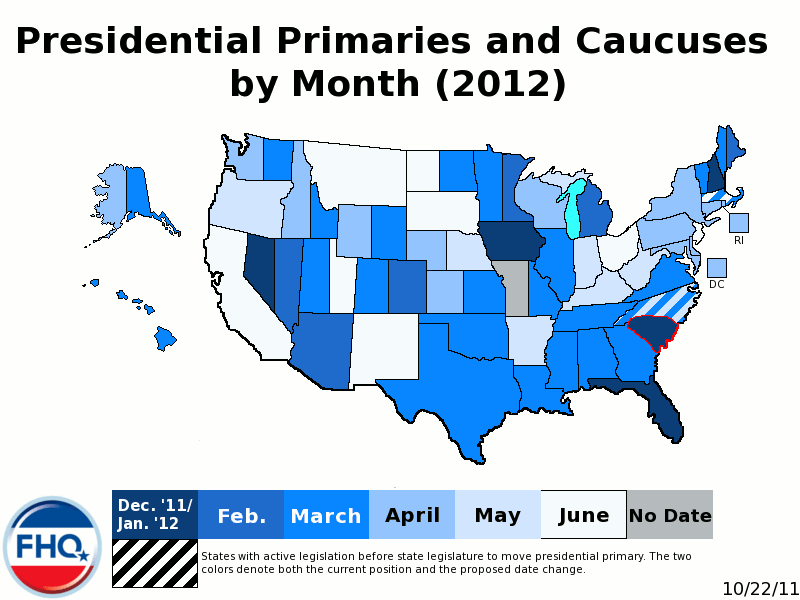
[Click to Enlarge]

The Ohio House passed and Governor John Kasich signed HB 318 on Friday. Each took action on the bill that creates a second 2012 primary election -- on June 12 -- for presidential and US House nominations a day after the Senate passed the amended version of the legislation. The move also shifts the Ohio presidential primary from a prime spot on Super Tuesday to almost the back of the line. Buckeye state voters will now go to the polls ahead of only Utah Republicans in the presidential nomination sequence.

For more on the reasoning behind the move, see FHQ's explanation from yesterday.

We'll have more on this and what it means later.


Are you following FHQ on TwitterGoogle+ and Facebook? Click on the links to join in.

Friday, October 21, 2011

Iowa Democrats to Caucus on January 3 -- And a Postscript

Joining their state Republican Party counterparts, the Iowa Democratic Party last night voted unanimously to hold January 3 caucus meetings. The delegate selection process will begin on January 3 and continue with county conventions on March 10 and district conventions on April 28 before wrapping up at the state convention on June 16.

--

FHQ has talked a great deal about the institutional advantages that New Hampshire has in this primary calendar date-setting process. But Iowa remains up front for various and different reasons as well. What the two share is both willingness and ability to do whatever it takes to stay at the beginning of the process. New Hampshire and Iowa have shared the willingness to be up front all along, but what separates each from the other states is ability to actually go early. What has changed over the last couple of presidential nomination cycles, though, is that the gap in ability is closing. New Hampshire, as we have witnessed over the last several weeks, has delegated the authority to set the date of the Granite state primary to just one person, the secretary of state. That insulates New Hampshire from the timing of state legislative sessions (when they are actually in session and can move the date of the primary), the partisan and institutional gridlock that can take place in those legislatures over something so seemingly simple as a primary date, and the sorts of inter-party conflicts that can occur across parties in caucus states.

To that latter point, FHQ should mention that this is where Iowa has been quite good over the years. The Democratic and Republican parties -- and recall state parties are making the decisions on the dates in most caucus states -- in Iowa have traditionally presented a united front in terms of the date of the precinct caucuses. If you can't or won't be a primary state, the next best thing is to act like a primary state. To the extent that the two parties in any state can act in concert, it is to their advantage. The goal of being early is to maximize the attention paid to the state, and if Democrats and Republicans in Iowa or any other caucus state can hold caucuses on the same date, it prevents the attention from being diluted.

Look no further than the Nevada example in 2011. The Nevada Republican Party moved the caucuses up and had the Nevada Democrats join them this week only to now appear as if they [NVGOP] will move back to February to accommodate the RNC and New Hampshire. Now, the Democrats in Nevada can pull out the chicken costumes and area reporters can say the Nevada Republicans caved, but that isn't entirely fair. Sure from the perspective of Nevada Democrats, if you want to be an early state you have to act like an early state -- mimic Iowa -- but this also points out the differences between Iowa and Nevada. Iowa has institutionalized the notion of both parties going on the same date. Nevada has not. Iowa can use that against the national parties in a way that Nevada either could or would not. And it should be noted that theoretically the national party should -- all things held equal -- be able to twist arms better with a state party than with a state government or an official therein. Bill Gardner may be a Democrat, but as secretary of state, he is apolitical when it comes to protecting both New Hampshire law and the position of the primary. He is above threats from either national party.

But why did the RNC go after Nevada and not Iowa?

Mostly that happened because Iowa acted in a way to end the push toward a 2011 start to the primary season. They set a January 3 date -- still early but in 2012 -- and that shifted the discussion from the vantage point of the RNC to one of how to fit everyone else in. And because of Gardner's position, it was always going to be easier to deal with Nevada than New Hampshire. The threats and incentives matter to the Nevada GOP in a way that they won't and never will to Gardner in New Hampshire.

So no, it isn't fair to say that the Nevada Republicans caved or will cave if they opt to move back in their state central committee meeting tomorrow. They could have carried on resisting a change, but that would have meant a short term gain at the expense of the state's longer term prospects for staying at the front. But this is a lesson to both parties in Nevada: act in concert in the future if you want to most effectively retain your early position.

...and do so before the last few months in the calendar-setting process.


Are you following FHQ on TwitterGoogle+ and Facebook? Click on the links to join in.

Thursday, October 20, 2011

Ohio Senate Passes Bill Creating Separate June Primary for Presidential and US House Candidates

The Ohio Senate today passed by a vote of 20-10 an amended version of HB 318. The bill, originally introduced and passed by the House with the intent of moving all of the primary elections in the Buckeye state from March to May, will now leave the state, local and US Senate primaries in March, but create an all-new and separate primary election in June for the presidential and US House nominations. Separate presidential primaries are nothing new. That some states have had separate presidential primaries while others have had those contests consolidated with primaries for state and local offices is one of the primary explanations for why some states are better able to move the dates of their presidential primaries than others.

The proposed separation in Ohio, however, is unique. To take the presidential and US House primaries and move them to a later date, separate from the other primaries, is a set up unlike anything FHQ has ever seen. And it is purely a function of the circumstances in Ohio in 2012. On its face, the move of the presidential primary seems less necessary than the shift of the US House primaries. The latter have a great many more question marks at the moment with unresolved congressional district boundaries.

Why, then, is a move of the presidential primary being proposed?

Rules. The Ohio Republican Party rules for allocating delegates [more on this in a later post] include an element that uses the congressional district vote to allocate the three delegates apportioned to each congressional district by the Republican National Committee. To uphold those newly-tweaked rules, the Ohio Republican Party needs the same sort of concession being afforded the congressional nomination (House) races for its presidential delegate selection. Both sets of races depend on the defined congressional districts that continue to be unresolved.

This potential change does have consequences. The presidential primary moves from being a Super Tuesday presidential primary battleground -- one with no clear link to any candidate1 -- to being at the tail end of the process. If passed, this legislation would potentially shift Ohio out of the window of decisiveness and that could have negative implications for the RNC and its presumptive nominee organizing in the state. It is not guaranteed, but the nomination will likely be decided by the time the process reaches Ohio on June 12. That means that the Buckeye state primary will not be competitive and an organizational opportunity could be missed. Could be because that competitiveness is always a double-edged sword. It can yield organization (Clinton-Obama) or divisiveness (Carter-Kennedy). Organization can always occur -- late or not -- but the effects of divisiveness sometimes cannot always be fixed in time for a general election.

Ohio will likely be a prime battleground in the fall general election campaign anyway. So, no harm, no foul.

If this bill does become law, it would move Ohio back to June alongside California and New Jersey; a significant cache of delegates that has not been so backloaded together since 1992 and before. HB 318 now moves onto the House for concurrence consideration in the lower chamber.

[NOTE: Creating the separate June primary will cost Ohio taxpayers $15 million.]

Thanks to Richard Winger at Ballot Access News for passing the news along.

--
1 Texas, for example, and perhaps the other southern contests on the same day could favor Rick Perry while the northeastern primary and western caucuses could favor Romney.


Are you following FHQ on TwitterGoogle+ and Facebook? Click on the links to join in.

Wednesday, October 19, 2011

New Legislation Introduced to Eliminate Missouri Presidential Primary for 2012

Missouri has had more second chances to set the date of its presidential primary or eliminate it than Stephen Garcia had stay on as Steve Spurrier's quarterback at South Carolina.  And yet, neither has happened yet.

The latest, following Monday's Senate rejections of all possible remedies to the situation left an $8 million state expenditure for a non-binding primary, is probably the last last-ditch effort Missouri will get before the Show Me state special session comes to a close. House Speaker Pro Tem Shane Schoeller (R-139th, Willard) today introduced legislation (HB 10) in the House to eliminate the presidential primary for the 2012 cycle. Depending on the national party delegate selection rules for 2016, that would leave Missouri at the front of the pack -- according to the various state election laws -- on the first Tuesday after the first Monday in February to start the 2016 calendar shuffling.

So, we have that to potentially look forward to.

For now, however, this bill, if passed, would save the state from seemingly wasting money in a tight budgetary context on a presidential primary timed at a point that would cost the Republican delegation to the 2012 Tampa convention half its members.


Are you following FHQ on TwitterGoogle+ and Facebook? Click on the links to join in.

Howard Dean: Right on Rules, Wrong on History

Former Vermont governor, presidential candidate and DNC chair, Howard Dean has an interesting op/ed online at the Washington Post. Basically, he is making the same arguments FHQ has been making since 2009 and 2010: That the delegate selection rules and penalties put in place by the Republican National Committee for the 2012 cycle were not sufficient to prevent the type of calendar positioning used by states  in 2008.  Said Dean:
But states do not have the legal right to change the national party’s rules. If the national parties are willing to use their power to protect the integrity of the process, they can force states into compliance. The Republican Party seems unwilling to do so. Its first mistake happened months ago, when it decided that states that move their primaries would lose 50 percent, rather than 100 percent, of their delegates. Under the current system, for example, even if Florida violates the rules and loses half its 198 delegates, it would still have more than New Hampshire (23) and Iowa (28) combined. As a candidate, if you think you can win Florida, there is no reason not to encourage the state to move its date.
...
As the RNC considers its options, it should remember that while states are under no obligation to pay for the nominating contests set by the national parties, the parties are under no obligation to recognize the results from states that have violated the rules. To preserve the agreed-upon system in this cycle, the RNC must show it is prepared to enforce the rules, and to consider additional sanctions if necessary.
Dean's right. He is correct that the lack of changes to the RNC rules have led to the Arizona mess, the Florida problem and the Nevada-New Hampshire dispute. FHQ also agrees with the former governor that the best way to keep states in line is to remove the carrot that entices states into moving in the first place: candidate and media attention (and the benefits that go along with that). By crafting and enforcing tough rules and penalties on violating states and by punishing candidates who campaign in those states, a national party would be on firm footing to deal with the "rogue" problem. Again, this is something that FHQ has recently argued in favor of.


In all fairness, particularly to the RNC, though, Dean has partially revised history here. The Democratic Party did not have a rule to strip a state of 100% of its delegates for violation of the timing rules during the 2008 cycle. Rule 20.C.1.a from the delegate selection rules that bear the former party chairman's name says:

Violation of timing: In the event the Delegate Selection Plan of a state partyprovides or permits a meeting, caucus, convention or primary which constitutesthe first determining stage in the presidential nominating process to be held priorto or after the dates for the state as provided in Rule 11 of these rules, or in theevent a state holds such a meeting, caucus, convention or primary prior to or aftersuch dates, the number of pledged delegates elected in each category allocated to the state pursuant to the Call for the National Convention shall be reduced byfifty (50%) percent, and the number of alternates shall also be reduced by fifty(50%) percent. In addition, none of the members of the Democratic NationalCommittee and no other unpledged delegate allocated pursuant to Rule 8.A. fromthat state shall be permitted to vote as members of the state’s delegation. Indetermining the actual number of delegates or alternates by which the state’sdelegation is to be reduced, any fraction below .5 shall be rounded down to thenearest whole number, and any fraction of .5 or greater shall be rounded up to thenext nearest whole number.
Yes, the DNC rules called for the same 50% penalty for which both the RNC and DNC rules for 2012 call. The DNC Rules and Bylaws Committee in the late summer of 2007 decided to make an example of Florida and increase the 50% penalty to 100%. That same penalty was imposed on Michigan when it did not heed the party's warning. 

Dean also forgets how all of this played out in 2008. The same Rules and Bylaws Committee later gave Florida and Michigan both half of their delegates back in a meeting the weekend prior to the last round of primaries in early June. And then the party seated the full delegations from both states at the Denver convention later in the summer. 

Howard Dean is absolutely right about the type of penalties and enforcement necessary to correct this quadrennial issue, but he in no way does his argument any service by claiming that the Democratic Party did not do in 2008 exactly what he claims the RNC is now doing. Both parties are guilty of caving into the states and it would benefit both to work together to craft a plan and enforcement mechanism that would help the two national parties present a unified front against any would-be rogue states in the future.


Are you following FHQ on TwitterGoogle+ and Facebook? Click on the links to join in.

"In return for forfeiting its coveted third-in-the-nation contest this year, Nevada would receive promises of stricter future sanctions to protect its early state status in the long term."

That's Anjeanette Damon of the Las Vegas Sun on the mounting pressure being placed on the Nevada Republican Party to shift back its presidential caucus meetings to accommodate the Republican National Committee, and probably more importantly, New Hampshire. Allow FHQ to shunt to the side the fact that Nevada may move into the fifth position on the presidential primary calendar behind Florida for a moment to focus on the stick the RNC is promising the Republican Party in the Silver state it will wield in future presidential election cycles. My question is simple:

How?

Better yet, how and in what ways does the RNC propose to unilaterally impose stricter sanctions in the future? To be fair, the parties have traditionally set and imposed -- or not imposed -- delegate selection rules with varying levels of success. The trajectory over the last two cycles is toward less success. But as I argued recently, that is likely a goal that is only attainable through the coordination of not only rules but penalties between the two national parties. A party could go-it-alone, but in an era when state-level actors are becoming much shrewder in their ways in which they challenge the prime calendar positions held by Iowa and New Hampshire -- and now Nevada and South Carolina -- it is becoming a much more difficult coordination problem. The states already have the upper hand here. To put in the terminology of my academic research, some number of states already have the willingness to move at will even into non-compliant positions on the calendar, but a smaller faction of that group is also enhancing its ability to not only move at will but to effectively vie for a lead position on the calendar.

FHQ takes the RNC at is oft-repeated word that it will maintain the penalties on rogue states heading into the Tampa convention next summer. I have also taken it as a fact that the RNC would revisit its rules in the intervening years between the current election cycle and the next primary season. But I am still left wondering what the RNC can do on its own to make states comply with national party delegate selection rules. It will take more than a 50% delegate hit, the seating of a rogue state's delegates behind load-bearing columns next to Guam at the convention and hotel assignments three states over to keep willing and able rogue states in line. This is even more problematic in light of the reality that presumptive nominees are motivated to forgive states their penalties in the interest of general election campaign party unity.

FHQ is not privy to these discussions between current-RNC Chair Reince Priebus and state Republican Party officials in Nevada, but I am curious about whether the Nevada Republicans ask the very same "How?" question. Honestly, it will take at least language similar to that used in the Republican Party rules concerning the informally agreed to calendar alignment codified in its modified 2008 rules (Rule 15.b.3):
If the Democratic National Committee fails to adhere to a presidential primary schedule with the dates set forth in Rule 15(b)(1) of these Rules (February 1 and first Tuesday in March), then Rule 15(b) shall revert to the Rules as adopted by the 2008 Republican National Convention. 
Theoretically, that same sort of tit-for-tat structure could work and informally bind the parties to shared penalties. Yes, that is open to the same sort of problems attendant to the current system. The states would still be tempted to test the parties and the national parties would still be tempted to back out and forgive potentially vital general election states their delegates (if that continues to be the penalty). That said, this is still the next logical step in the rules/penalties progression. The parties are motivated to do as little as possible to the current system because it still fulfills its basic function of nominating candidates well-equipped for the general election and for fear of unintended consequences.

Of course, in the end, the RNC could just be banking on a win in 2012 so that they can pass the calendar headache on to the Democratic National Committee alone for the 2016 cycle.

--
Now let's have a look at the Nevada situation.

The RNC is pushing an incentive-ladened package on the Nevada Republican Party in the hopes that Silver state Republicans will move back into February to make enough room for New Hampshire between Iowa and South Carolina. They get...

  • a protected position in the pre-window period
  • a promise of stronger future sanctions
  • to keep first in the West status
  • to keep a full slate of delegates for holding a rules-compliant contest
  • a promise of high-level party surrogates to raise money in the state (It is unclear, though, likely this is for the general election. But those funds could also be utilized to organize in order to avoid some of the party's caucus system problems in 2008.)
  • a date -- presumably February 4 -- all to themselves four days after the Florida primary and three days before non-binding caucuses in Colorado and Minnesota. Maine Republicans will begin their process on February 4, but that will not end until February 11 when all of the caucuses have been completed. That Nevada has delegates at stake would hypothetically attract the candidates more than the three non-binding contests list above. [FHQ will have more on the Missouri situation later this evening. The Show-Me state is also slated to hold a non-binding primary on February 7 as of now.]
  • no more headaches at the mere mention of Bill Gardner's name. 
  • no more pressure from the RNC, Iowa Republicans and New Hampshire's Republican leadership, elected officials and media outlets.

Is that enough to persuade Nevada Republicans into moving and quelling the calendar "chaos" at the beginning of the calendar? It seems that way, but we won't know for sure until the Saturday, October 22 meeting of the Nevada Republican Party Central Committee.


Are you following FHQ on TwitterGoogle+ and Facebook? Click on the links to join in.