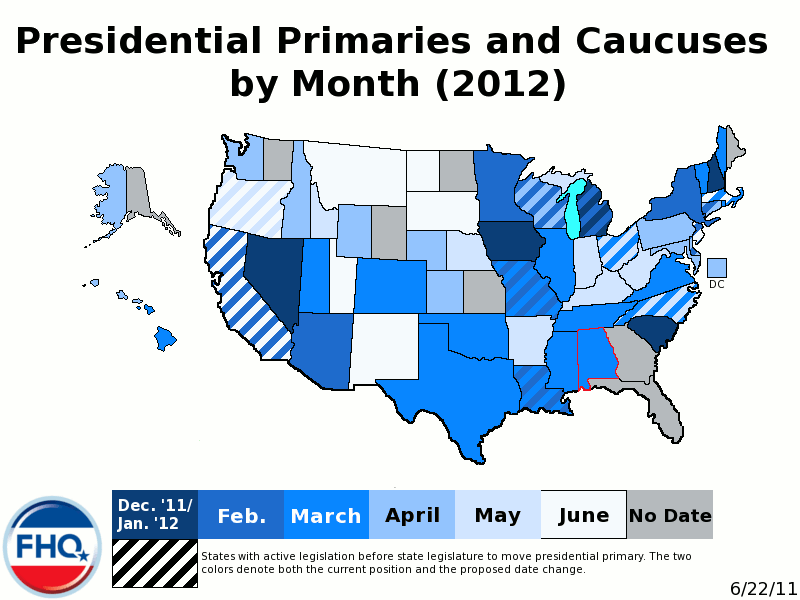
Wednesday, June 22, 2011

Ohio Secretary of State Supports May Presidential Primary

Last month FHQ looked at the efforts by the Ohio General Assembly to position the Buckeye state's presidential primary in 2012. Omnibus elections legislation passed the House to shift the contest back from the first Tuesday after the first Monday in March to the first Tuesday after the first Monday in May, but the Senate version conflicted with the House-passed version. One of those differences was the date of the presidential primary. The Senate bill -- now in the House -- would keep the primary in March.

Indeed, the move to May is something that has been on the radar since the the beginning of the legislative session in January when Secretary of State John Husted (R) raised the possibility that the redistricting process could hamper the 2012 presidential primary in the state. Husted, at that time however, did not come down on one side or the other of the primary timing discussion. As the legislature's focus begins to shift from the budget to the redistricting process, though, his position has hardened in support of moving the contest to May. The primary impetus behind the shift is to allow elections administrators the opportunity to prepare for elections given the changing congressional and state legislative districts.

But lost in the discussion is the fact that Ohio Republicans have typically used some form of winner-take-all delegate allocation and with a March primary date the party would be susceptible to sanctions from the RNC should they not shift to proportional allocation as called for by the Republican delegate selection rules. A May date would help the state party avoid that issue. A change in the allocation of the at-large delegates based on the statewide results would also accomplish that, however.

Regardless, it appears as if there is support for the May primary date in the one place it had not been earlier, the Senate. The House bill with the May primary date provision is on the Senate Government Oversight and Reform Committee agenda both today and tomorrow and could be reported to the full Senate as a result. According to Secretary Husted, there is support in the Senate for the change.


Rhode Island House Committee Amends House and Senate Elections Bills to Move Presidential Primary to April

On Tuesday, June 21, the Rhode Island House Judiciary Committee recommended the passage of H 5633 and S 399, two bills meant to bring the BayOcean state's presidential primary process into compliance with the federal MOVE act. However, the committee amended the bills, changing the date of the presidential nominating contest from the first Tuesday in March to the fourth Tuesday in April. This is the first action in Rhode Island toward the goal of an April 24, 2012 regional primary based on the chatter from Connecticut. The legislation would bring the state's contest in line with those in Pennsylvania, Connecticut (if legislation is signed), New York (if legislation is signed) and Delaware (if legislation is passed and signed).

[Click to Enlarge]

Both Rhode Island bills are on the WednesdayThursday House calendar for consideration and potentially votes by the full lower chamber.

This legislation will be added to the Presidential Primary Bills Before State Legislatures section in the left sidebar.


And then there was New York: Last February State Rapidly Moves Bill Through Legislature

The New York presidential primary has been in the news lately in regard to some chatter about a possible regional primary with Pennsylvania, Connecticut, Delaware and Rhode Island coordinated on April 24. However, there had been little movement on that front until last week, the last week of the session before the Empire state legislature adjourned for the year on June 20. On June 14, both A8363 and S5753 were introduced and by the end of the week both had passed both the Assembly and the Senate. This clears the way for New York -- assuming Governor Cuomo signs the legislation -- to join the other mid-Atlantic/northeastern states on April 24.


[Click to Enlarge]

There are a couple of interesting notes attendant to this legislation. First of all, nothing in the bill does anything about what will be a non-compliant fall primary in September 2012. If held, the fall primary will be a violation of the federal MOVE act. Technically, there would be time to make that change next year, but it seems like an undue burden for the legislature in an election year. Secondly, the bills above specifically cite April 24, 2012 as the date of the primary. That means that New York will have a set primary date for the 2012 cycle, but beyond that the primary date will be in limbo. The date won't, for instance, reset to the first Tuesday in February or March in 2016 as has been seen in the past from other states (see Massachusetts and Michigan from the 208 cycle). Instead the primary will be shifted for the current cycle without provision for future cycles. In other words, the issue will have to be readdressed in a subsequent legislative session.

New York becomes the final non-compliant state -- February date or earlier -- to make some effort to bring its delegate selection event within the bounds of the national parties' delegate selection rules for 2012. Every state has now acted with the exception of Arizona, and to this point, Michigan has shown no signs of moving back. Legislation in the Wolverine state proposes moving the primary up to the last Tuesday in January.

This legislation will be added to the Presidential Primary Bills Before State Legislatures section in the left sidebar.


Alabama Presidential Primary to March 13

[Click to Enlarge]

Lost in the shuffle of all the other bills Governor Bob Bentley signed on June 9 was HB 425, the bill to move the Alabama presidential primary to the second Tuesday in March from the first Tuesday in February. The legislation also shifts the primaries for state and local offices up from the first Tuesday in June to coincide with the presidential primary; a move that will save the state nearly $4 million. Alabama will join western neighbor, Mississippi, with a presidential primary on the second Tuesday in March.

Alabama now becomes the seventh state to move its presidential primary back to a later date in order to comply with national party rules, but the first to consolidate its presidential primary with those for state and local offices as a means of saving money.


Tuesday, June 21, 2011

Louisiana Senate Passes March Presidential Primary Bill, House Concurs

On Monday, June 20, the Louisiana state Senate passed HB 509 by a 27-9 vote. The Senate-amended version of the bill would shift the Pelican state's presidential primary from the second or third Saturday in February to the third Saturday after the first Tuesday in March. The House had earlier passed the legislation, but that version would have called for the primary to have been held two weeks earlier, a date that conflicted with the Passover holiday. The state House unanimously concurred (91-0) with the Senate and Governmental Affairs Committee changes on Tuesday, June 21, and sent the bill to Governor Bobby Jindal (R) for his consideration.

The bill would move Louisiana back into compliance with the informally coordinated national party rules governing delegate selection for the 2012 presidential election cycle.


Friday, June 17, 2011

Delayed Louisiana Primary Bill Narrowly Passes Senate Committee Stage

The Louisiana Senate and Governmental Affairs Committee once again took up HB 509, two days after the panel deferred on the legislation to move the Pelican state's presidential primary back into compliance with the national party rules. FHQ tuned into the hearing just in time to catch the vote and following another effort by Senator Karen Carter Peterson (D-5th, New Orleans) to defer the bill again was defeated by a 5-4 margin, committee chair, Senator Bob Kostelka (R-35th, Monroe), broke a tie with and thus reported the bill favorably to the floor of the Louisiana Senate.

The bill would move the Louisiana presidential primary from second or third Saturday in February to the third Saturday after the first Tuesday in March. Should the bill pass the Senate it would have to return to the House to be reconsidered there. The original bill that passed the House would have moved the primary to the first Saturday after the first Tuesday in March; a date that would conflict with Passover.

NOTE: Once I've had a chance to review the committee hearing I'll update the post with any pertinent discussions from the committee.


Delaware Senate Votes to Pass April Presidential Primary Legislation

The Delaware state Senate on Thursday, June 16, passed SB 89 by a 19-1 vote. The bill would move the First state's presidential primary from the first Tuesday in February to the fourth Tuesday in April; coinciding with primaries in neighboring Pennsylvania and when Governor Malloy signs the legislation in the Nutmeg state, Connecticut.

The bill will now move to the Delaware state House for consideration and will have to be moved through the lower chamber prior to the legislative session adjourning at the end of the month.


Thursday, June 16, 2011

Louisiana Senate Panel Defers Presidential Primary Bill

With more or less a week to go in the legislative session, the Louisiana Senate and Governmental Affairs Committee dealt a seemingly serious blow to the bill to shift the Pelican state presidential primary back into compliance with national party delegate selection rules. By a vote of 6-1, the panel deferred on HB 509. The bill proposes moving the Louisiana presidential primary from the second or third Saturday in February to the third Saturday after the first Tuesday in March.1 Discussion around the bill was very limited before Senator Karen Carter Peterson (D-5th, New Orleans) made a motion to defer the bill. Senator Mike Walsworth (R-33rd, West Monroe) was the only member of the committee to question the Representative Alan Seabaugh, the House member speaking on behalf of the bill. Walsworth focused mainly on the costs of the move to taxpayers2 and on a repeated line of questioning as to why Louisiana was not trying to hold its primary on Super Tuesday.3

This was a strange move by the committee, but in FHQ's opinion -- having watched the hearing -- the deferral was more a matter of fatigue on the part of the committee than of playing politics with the date of the presidential primary. The committee had several nominations on their agenda and the chair, Senator Bob Kostelka (R-35th, Monroe) mentioned from the outset of the hearing that the committee wanted to move quickly through the consideration of bills and onto the nominations before them. Following lengthy discussions of a resolution to call on Congress to deal with the national debt and of a proposed Ten Commandments monument on the Louisiana state capitol grounds, the members of the committee, already two hours into the meeting, seemed eager to move on to those nominations.

In fact, reports of the death of this bill seem to have been premature, as it is slated to be reconsidered by the Senate and Governmental Affairs Committee during its next meeting Friday morning. Should the bill be killed in that meeting, the implications are not that severe,4 despite warnings of delegate penalties. FHQ would expect both parties to abandon the non-compliant primary in favor of caucuses. The Republican Party in Louisiana has already indicated that it would do so, and Democrats, with an uncompetitive nomination race before them, would likely follow suit.

Thanks to Richard Winger at Ballot Access News for sending along the link the New Orleans Times-Picayune story.

--
1 The House-passed version of the bill would move the primary to the first Saturday after the first Tuesday in March, but the Louisiana secretary of state's office raised concerns over the conflict that date would have with Passover. Louisiana law -- like those in other states -- prohibits elections on religious holidays, and thus mandated an amendment to the original bill.

2 There would be no extra costs. The third Saturday after the first Tuesday in March is a date on which elections to 158 municipal elections in addition to both major parties' state central committees are held. That the presidential primary would coincide with those elections would actually save Louisiana taxpayers money.

3 Louisiana has not held a presidential primary on Super Tuesday since 1992. The calendar was more jumbled that year without a clear Super Tuesday after the collection of southern states that had held the most concerted regional primary to date in 1988. Regardless, Louisiana stuck with the second Tuesday in March date for its primary until the 2008 cycle; a date that had seen a large number of states pass by moving to earlier dates over that twenty year period.

4 That "severity" could certainly be a point of contention. Obviously a switch to caucuses would translate into much lower participation in the contest and that has its own implications. The point here, however, is that Louisiana, despite the warnings, will not lose delegates to either the Democratic or Republican conventions. The state parties will switch to compliant caucuses before allocating delegates via a non-compliant primary.


Friday, June 10, 2011

California Senate Committee Unanimously Passes June Primary Bill

During a Wednesday, June 8 hearing, the California state Senate Elections and Constitutional Amendments Committee voted unanimously to recommend AB 80 for passage before the full chamber. The legislation would shift the date of the California presidential primary from the first Tuesday in February to the first Tuesday in June; eliminating the separate presidential primary election and consolidating it with primaries for state and local offices.

To this point AB 80 has received full bipartisan support on both the committee and floor levels in the Assembly and now in committee in the Senate. However, it is unclear as to whether the bipartisanship will continue as the bill approaches its likely final legislative hurdle. Senate Minority Leader Robert Dutton (R-31st, Rancho Cucamonga), earlier in the session, was quite vocal about the late primary within the context of the budget discussions. But that talk has dissipated of late. Any opposition will emerge soon enough, but will only be token at best -- especially if only from Republicans -- in the Democratic-controlled upper chamber.

A doff of the cap to Richard Winger at Ballot Access News for passing the news along.


Wednesday, June 8, 2011

April 24th Primary Bill Passes Committee Hurdle in Delaware Senate

The Delaware state Senate Administrative Services/Elections Committee on Wednesday considered and passed SB 89 with a 4 (out of the six members) on the merits. That basically clears the way for the bill to be considered by the full Senate in relatively short order and be moved from one Democratic-controlled chamber to the next before the session ends at the end of June.

SB 89 is now on the Senate's "Ready List" and could be debated and voted upon quickly in the near future. The bill would move the First state's presidential primary from the first Tuesday in February to the last Tuesday in April -- the same date as Pennsylvania and as Connecticut is targeting with with legislation to move the primary there.


Wisconsin Senate Passes April Presidential Primary Bill

Fast track is right.

The day after the Wisconsin Senate Transportation and Elections Committee passed SB 115 -- making it available for consideration on the floor -- the full state Senate took up the matter. On a voice vote with no opposition, the legislation to move the Badger state presidential primaries back into compliance with national parties' rules -- a point the bill's sponsor Sen. Mary Lazich raised in her short statement of support for the bill -- passed the Senate.

The amended version of the legislation now heads to the Assembly for consideration by the lower chamber. The committee amendment agreed to by the full Senate in no way affects the presidential primary date change -- from the third Tuesday in February to the first Tuesday in April -- but does clarify language regarding the deadline by which the Wisconsin Government Accountability Board must submit a certified list of presidential candidates to local elections officials.


Unanimous Late Night Senate Vote Sends April Primary Bill to Connecticut Governor

Not long before midnight on Tuesday, June 7, the Connecticut Senate unanimously passed (36-0) HB 6532. The legislation proposes moving Connecticut presidential primary from the first Tuesday in February to the last Tuesday in April and now moves on to the executive stage of the process. With unanimous support in both chambers of the legislature, Governor Dan Malloy's (D) support is expected.

If signed, the bill would bring the Connecticut primary in line with the presidential primary in Pennsylvania. Delaware is also eying that date with legislation active in the First state's legislature and there have been hints that New York and Rhode Island may also schedule their contests for that date.


Tuesday, June 7, 2011

Republican National Committeeman for Texas Warns of Penalties for March/Winner-Take-All Primary

See update at the conclusion of the post.

In a letter to Texas state legislators, Republican National Committeeman for Texas and General Counsel to the Republican National Committee, Bill Crocker, again warned of the sanctions Lone Star state Republicans are facing by holding a March 6 presidential primary.1 Under the rules of the Republican Party of Texas, there is a winner-take-all element to the allocation of delegates, thus potentially making Texas Republicans vulnerable to the penalties laid out in the Rules of the Republican Party (Here's a link to a summary memo of these specific rules.). But that isn't the point Mr. Crocker is making. He treats the Texas Republican rules regarding the allocation of delegates as strictly winner-take-all. That, however, is somewhat misleading and as a result Mr. Crocker overstates his case in the letter.

Here is that segment of the letter in question:

Under our present law, the Texas presidential primary must be held on the first Tuesday in March, which in 2012 will be March 6. The Rules of the Republican Party (the national party rules) provide that delegates to the 2012 Republican National Convention from a state which has a March primary, if bound by the results of that primary, must be allocated among the primary candidates in accordance with the results of the primary election "on a proportional basis." [Rule 15(b)]

The Rules of the RPT require national convention delegates from Texas to vote in accordance with the results of the Texas primary, and require allocation of delegates among the candidates on a basis which may not be considered proportional. Our delegates from a congressional district are allocated on a winner-take-all basis to the candidate who obtains more than 50% of the primary votes in that congressional district. Our at-large delegates are allocated on a winner-take-all basis to the candidate who obtains more than 50% of the primary vote in the state.

Now, Mr. Crocker is absolutely correct on a couple of counts. First, Sections 8 and 9 of the General Rules for All Conventions and Meetings from the Republican Party of Texas state essentially what Mr. Crocker has already stated: at-large delegates are allocated on a winner-take-all basis if one candidate wins more than 50% of the statewide vote in the Texas primary and congressional district delegates are allocated in a similar fashion on the district-level vote (win more than 50% of the district vote, receive all the delegates). He is also right that any Republican contest scheduled prior to April 1 must allocated delegates proportionally. What is misleading though, is that the rules are not explained fully. That proportionality requirement, as FHQ highlighted in our original write-up concerning the memo from the RNC (link above), is not quite so strenuous in its application as some have interpreted.

For starters, the only delegate allocation that the proportionality requirement applies to is the allocation of at-large delegates. The winner-take-all allocation of congressional district delegates is fine then. But let's take a closer look at how the Texas allocation rules square with the RNC rules. Is there a problem? More importantly, if there is a problem is it as dire as the picture Mr. Crocker is painting?

FHQ's reading of the situation is that Texas is largely compliant with the RNC's delegate selection rules for 2012. The only issue is that if a candidate receives 50% or more of the vote in the Texas presidential primary on March 6, the winner-take-all provision in the Texas plan will be triggered. Is there a problem? Yes, but will it crush the Republican Party of Texas in terms of penalties? Only if one candidate surpasses the 50% mark in the vote total.

How likely is that, though?

If Mitt Romney reels off a winning streak in the early states, sweeping Iowa, New Hampshire, Nevada and South Carolina (and perhaps Arizona, Florida, Michigan and Minnesota should those states hold non-compliant February contests), the field may have been winnowed down to the point that "Mitt is inevitable" reality becomes, well, inevitable. That might have the effect of making Texas and all the other March and later contests largely meaningless -- merely ratifying the decisions of the earlier states. The margins of victory for the inevitable nominee would rise and likely, as was the case for John McCain in 2008, above 50%. Could that happen? Sure, it is still early enough that that possibility is still on the table. But it isn't the only possibility and it may not even be the most likely possibility.

What's more likely, at least in FHQ's estimation, is that some other candidate or candidates emerge(s) as the alternative to Romney in those early state contests. In other words, the extent to which the race remains competitive once the presidential primary sequence reaches Texas and the other March 6 (Super Tuesday) states will determine the likelihood of one candidate receiving 50% of the vote statewide and all of the Lone Star state's at-large delegates. 2008 isn't the only guide, but in the most competitive Super Tuesday states three years ago -- the big delegate prizes on February 5 -- few featured candidates who crossed the 50% barrier. Texas will be a delegate treasure trove on March 6, and will thus attract a great deal of candidate and media attention. That doesn't guarantee that Texas will be competitive, but it lends itself to that conclusion. So, maybe there was a reason Texas voters weren't terribly excited about the idea of Governor Rick Perry running for president: they didn't want a favorite son to make Texas less competitive and possibly cost the state's Republican delegation half of its members.

At this juncture, FHQ would say that Texas is safe; not completely safe from sanctions, mind you, but safe relative to the doomsday scenario Mr. Crocker describes in his letter. Now, I want to be clear that I'm not trying to be hard on Mr. Crocker. Faced with a choice between completely safe with an April 1 primary or mostly safe where Texas is currently scheduled, you'd probably opt for the former if you are within the party elite. But as general counsel for the RNC, Mr. Crocker should be clear in laying out what potentially faces the state party.

--
Update: As Mystery Politico rightly points out in the comments section below, there is a minimum threshold that a state party can set whereby all the delegates from a state are allocated on a winner-take-all basis (see Section III.v in the memo linked above). As long as a state sets a minimum threshold no lower than 50%, the proportionality requirement is completely negated. If a state, then, sets a 50% threshold and a candidate receives 50% of the vote, that candidate could walk away with all of the delegates from the state.

...even in a contest prior to April 1. As I said in the comments, I'm as guilty as Bill Crocker in overstating the severity of the problem. There is no problem. Texas is fine with their plan as it currently stands. What's most troubling is that the general counsel for the RNC did not know this.

--
1 Mr. Crocker made a similar point in stressing the importance of a shift to April in testimony to the House Defense and Veterans' Affairs Committee concerning HB 111 this past April.


April Presidential Primary Bill Advances Out of Wisconsin Senate Committee

On Tuesday, June 7, the Wisconsin Senate Transportation and Elections Committee quickly dispatched with SB 115 in an executive session. The bill, sponsored by committee chair, Sen. Mary Lazich (R-28th, New Berlin), would shift the presidential primary in the Badger state back from the third Tuesday in February to the first Tuesday in April and was unanimously favored by the committee.

The committee vote was 5-0 and presumably moves the bill to the floor for consideration by the full state Senate. The state Assembly version is due to be considered by the Election and Campaign Reform Committee on Thursday.


Utah Republicans Opt to Link 2012 Presidential Primary to Late June State & Local Primaries

The Utah Republican State Executive Committee has voted to schedule the party's presidential primary for June 26, 2012. That fourth Tuesday in June date is the date on which the state has traditionally held its primaries for state and local offices. According to Bob Bernick at UtahPolicy.com, the state party had a decision to make between holding caucus meetings during the parties' mass meetings to start the state convention delegate selection process in March or moving the primary back to June to coincide with the other primaries in the state. The State Executive Committee opted for the latter. Concerns over keeping the contest closed to registered Republican voters were paramount in the committee's decision:
[Utah Republican Party Chairman Thomas] Wright said since Republicans hold closed primaries, with only registered party members voting, it would be a technical nightmare in the caucus meetings to try to determine who was legally a GOP registered voter – and thus able to cast a ballot in the presidential race.

It’s possible some registered Republicans would be turned away – making them really mad – while some Democrats or independents would be allowed to vote, violating GOP rules.

So, GOP Utah leaders decided it would just be better all around to hold their presidential primary on the regular primary election date – the last Tuesday in June.

Since both Democrats and Republicans will be holding any statewide or local primary elections on that June day, it won’t cost the state or counties any more money to hold a statewide presidential primary vote that day, said Wright.

Recall that what set this move to June in motion was the state legislature's decision during its January-March session not to fund the scheduled February 2012 presidential primary in the Beehive state. That shifted the decision to the state parties. Utah Democrats have already chosen to begin the delegate selection process with March 13 caucus meetings -- the former option mentioned above. Then again, Utah Democrats did not have much of a choice. The party could have opted for the mid-March caucuses or caucuses on some other date. The June primary would have been too late according to the Democratic National Committee's 2012 Delegate Selection Rules. Those rules mandate that non-exempt primaries and caucuses be scheduled between the first Tuesday in March and the second Tuesday in June (Rule 11.A). The RNC rules have a similar mandate on the front end of the calendar, but not on the back end. In other words, the late June presidential primary in Utah is compliant with the RNC rules but not with DNC rules.

[Click to Enlarge]


Friday, June 3, 2011

The 2012 Candidates (6/3/11)

Added:
Candidacy announcements: Cain, Pawlenty, Romney
Out: Daniels, Trump
New classifications: "latest denials"1, "reconsidering"

--
Democrats:
Barack Obama (announced: 4/4/11)

Republicans:
Michelle Bachmann
Haley Barbour (4/25/11)
John Bolton
Jeb Bush (latest denial: 5/23/11)
Herman Cain (exploratory: 1/12/11) (candidacy: 5/21/11)
Chris Christie (latest denial: 6/1/11)
Mitch Daniels (5/22/11)
Jim DeMint (latest denials: 3/24/11, 6/1/11)
Newt Gingrich (exploratory: 3/4/11) (candidacy: 5/11/11)
Rudy Giuliani
Mike Huckabee (5/14/11)
Jon Huntsman
Bobby Jindal (12/8/10)
Gary Johnson (candidacy: 4/21/11)
Roy Moore (exploratory: 4/18/11)
Sarah Palin
George Pataki (4/20/11)
Ron Paul (exploratory: 4/14/11) (candidacy: 5/13/11)
Tim Pawlenty (exploratory: 3/21/11) (candidacy: 5/23/11)
Mike Pence (1/27/11)
Rick Perry (latest denials: 4/15/11, 5/20/11) (reconsidering: 5/25/11)
Buddy Roemer (exploratory: 3/3/11)
Mitt Romney (exploratory: 4/11/11) (candidacy: 6/2/11)
Rick Santorum (exploratory 4/13/11)
John Thune (2/22/11)
Donald Trump (5/16/11)

--
1 This classification has been added for prospective candidates who have been repeatedly asked and denied and intention to run for president (ie: Christie, Bush). Prospective candidates who have issued definitive answers but about whom rumors have forced more recent denials are also included in this categorization (ie: DeMint).


Thursday, June 2, 2011

Missouri State Rep Raises Specter of Gubernatorial Veto on Presidential Primary Bill

Democratic Missouri representative, Tom Shively (D-8th, Shelbyville), in a column in today's Linn County Leader, raised doubt as to whether SB 282 -- the legislation passed by the Missouri General Assembly to move the presidential primary back to March -- would be signed by Governor Jay Nixon. But the veto would not arise because of the presidential primary provision. No, what is at issue instead is a provision in the bill curtailing gubernatorial power -- specifically the power of appointment to statewide offices in the event of a vacancy.

Shively:
Although Nixon hasn’t publicly announced his intentions on [sic] HB 282, governors typically don’t give up power voluntarily, and another provision of the bill would take away the gubernatorial authority to appoint replacements to vacancies in the offices of U.S. senator, lieutenant governor, secretary of state, state treasurer, state auditor and attorney general. Such vacancies are uncommon but are seen as golden opportunities for a governor to shape the political landscape when they do occur. [sic] HB 282 would require that such vacancies be filled by special election.
This is an interesting conundrum for Nixon. He faces, on the one hand, curbing his and future Missouri governors' powers, but on the other, the very likely stiff penalties on the Show Me state's Democratic delegation from the DNC for willingly violating the national party's delegate selection rules. Legislators (and governors) who do not actively seek to remedy such a conflict are subject to penalties equal to the 50% penalty called for in the rules (Rule 20.C.1.a, Rule 20.C.7). As Shively also mentions a veto override is possible, but would require the support of at least three Democrats in the state House (the margin is more comfortable for Republicans in the state Senate.). But the Democratic caucus in the state House would face the same sort of dilemma Nixon is staring down on this issue, except the legislators would not have as great a need to preserve executive power.

The writing seems like it is on the wall on this one. If FHQ had to guess, we would guess that Nixon will sign the bill if a veto override is likely. [Of course he didn't do that on the recent redistricting plan legislation when four Democratic representatives joined Republicans in overriding the governor's veto.]


New Jersey State Senate Committee Votes in Favor of June Presidential Primary Bills

The New Jersey state Senate State Government, Wagering, Tourism and Historic Preservation Committee this afternoon voted in favor of legislation to eliminate the Garden state's separate presidential primary, combining it with the state and local primary elections during the first Tuesday in June.

On the discussion of the senate version of the bill (S 2883) Committee Vice Chair Sen. Mark Gordon (D-38th, Fair Lawn) -- a sponsor of the 2005 legislation creating the separate presidential primary -- made the point that part of the motivation for moving the primary in the first place was that such a move would net the state more attention and thus money from candidates and the media. He argued that that potential gain would offset any savings the state would have for eliminating the separate primary.

Senator Shirley Turner (D-15th, Trenton) countered that she had not voted for the 2005 bill and that she was for the elimination of the separate presidential primary, citing the fact that New Jersey has "too many elections". The committee's chair, Senator Jim Whelan (D-2nd, Northfield) came down between Turner and Gordon, having voted for the 2005 measure creating the new election while in the Assembly, but favoring the cost savings ("8 to 10 million bucks") this time around.

Votes were cast on both A 3777 -- the Assembly-passed version -- and S 2883. Both were favorably reported by 4-1 votes with Gordon the only dissenting vote in both cases. The bills will now move to the Senate floor for consideration by the full chamber.


The Big Advantage New Hampshire Has Over Florida on Primary Scheduling

Basically, it can be summed up in one simple explanation: New Hampshire has done it before.

More and more Florida elections officials are expressing concern over newly-passed elections law in the state, but more to the point, the uncertainty surrounding the scheduling of the Sunshine state's presidential primary (via Aaron Deslatte at the Orlando Sentinel's Central Florida Political Pulse Blog):

Indian River Elections Supervisor Leslie Swan has qualms about the elections reform Gov. Rick Scott signed into law last month – specifically, the provision that creates a new commission and gives its members until October to set the date for the state’s presidential primary.
Swan said in a press release Wednesday that the timing might not give county election supervisors enough time to train poll workers and choose voting locations.
“The uncertainty of the exact date for the Presidential Preference Primary Election really leaves our office in a difficult position as far as scheduling training for our poll workers and securing polling locations,” Swan said.
“We are hoping for a decision prior to the October 1, 2011 deadline in order to prepare for this election.”
The Presidential Preference Primary Date Selection Committee (PPPDSC) was created to provide Florida with the flexibility to set the date of their primary outside of the confines of the early state legislative session. The byproduct of this, however, is that the burden has been shifted from a state legislature having to act within a very small window of time to local elections officials having to prepare for a primary election in an unknown period of time. If the PPPDSC waits until the October 1 deadline to set a date and chooses the earliest possible date -- January 3 -- that would leave elections officials in Florida just three months to prepare.

Is that enough time? Who knows? Florida has never been in this position before. Well, Florida elections administrators haven't anyway. It should be noted that there was plenty of uncertainty surrounding the Florida primary in 2008; not the date so much, but whether it would be held and/or whether it would count. Of course, the state had that January 2008 primary in place as of May 2007 and acted as if there were no problems (The state was and is Republican-controlled and all the attention to Florida in 2008 was on the Democratic side in terms of the penalties for holding an early, pre-window primary.). Elections officials had time, in other words. In 2012, they will not have as much warning/preparation time.

Things operate slightly differently in New Hampshire. The scheduling flexibility is there as well with the decision resting in the hands of the secretary of state (Only current secretary of state, Bill Gardner (D) has ever held the date-designating power since the transition from state legislative control over that decision before the 1976 primary.). But New Hampshire has done this before. And though local elections officials were wary of having to prepare for a primary with an unknown date as late as November 2007 -- a primary that was rumored to potentially take place in mid-December of that year -- they were still confident that they could pull it off with as little notice as a week or two.

Granted, Gardner waited until the eve of Thanksgiving to choose the date for the 2008 primary in 2007, so waiting Florida out until October 1 at the latest will be comparatively easy in 2011 relative to 2007.1 Still, even absent that previous experience, New Hampshire has added flexibility in setting a date than Florida does. This may not be a big item now, but as the fall rolls around, we may start hearing more about it.

--
1 Georgia's new December 1 deadline for its secretary of state to select a presidential primary may be more problematic to Gardner and New Hampshire.


Wednesday, June 1, 2011

Dogpile on Iowa and New Hampshire ...Again.

Is it that time again?

The time for everyone to pile on Iowa and New Hampshire for being the unrepresentative states at the front of the presidential primary and caucus line.

It seems that way. But now, instead of it being about the racial unrepresentativeness,1 it's about the urban-rural discrepancy and the resulting economic policy. The policy bit has been covered. Andrew Taylor showed -- without the quips about the position Iowa and New Hampshire occupy on the calendar -- that the earlier a state is the more it gains in promises from candidates and the more it gains in terms of candidates-turned-presidents' concessions once they are in the White House.

Now, a normative argument could be made for allowing other states to have a turn at the front to enjoy the fruits of being there. But that completely misses the point. So too, does Leonhardt's emphasis on the notion of one person-one vote in his New York Times take down of Iowa and New Hampshire on both urban-rural and policy concessions grounds. FHQ should go on record as saying that it is an advocate of one person-one vote, but primaries and caucuses or nominations for any office are not necessarily the domain of one person-one vote. Nominations, whether for president or dog catcher, are the business of the parties that conduct them. General elections, on the other hand, are about electing someone from one party or another to fill a particular office. The latter is democratic. The former isn't necessarily.

The idea of a general election is to let whomever wants to register to vote vote and have as equal a voice as possible. But nominating contests are not about that. Nominations are about the parties nominating someone to run in that general election. And the parties can choose whatever rules for govern that process that they want. It's their business.

Want to set the rules to produce the best candidate for the general election? Go for it.

Want to set the rules to produce the candidate who is the best ideological fit regardless of their chances in the general election? Again, go for it.

Want to set the rules to produce only balding, white males with yellow eyes -- so help me God, yellow eyes? Hey, more power to ya.

The point is that parties set the rules governing their nomination races. And no, they don't necessarily have to be democratic or fair. It just has to appear that way or appear enough that way. The courts have continually found in favor of the parties on this front (see the Tashjian case from the Supreme Court docket in 1986). The parties want to stick around for the long haul, and ideally to achieve that end they will have to be pragmatic and find enough electable candidates and minimize the Christine O'Donnells while still allowing for those sorts of results to occur.

But at the end of the day, it is up to the party to decide on the rules. And if that means Iowa and New Hampshire go first in the presidential primary process, then tough. When and if Iowa and New Hampshire produce a nominee that is unpalatable enough in the eyes of the party -- whichever party -- that a change at the front of the queue becomes necessary or even unavoidable, the party or parties will alter the rules. And honestly, I can't remember the last time someone argued that it was Iowa's and/or New Hampshire's fault that a certain candidate won a nomination and cost a party the chance at the White House. [It is usually the candidate that is thrown under the bus, not the voters who chose them eight or nine months prior.] Sure, that argument could be made, but it hasn't (or hasn't been effectively).

The bottom line is that Iowa and New Hampshire, despite their warts, do what they're suppose to do -- or at least do well enough at what they're supposed to do -- to keep their positions. If they didn't the parties would change it. And we may be approaching that point. All the talk about Iowa this time around has been about how the potential is there, due to the rightward "lurch" of the Iowa Republican caucusgoers, for an extreme candidate to win the caucuses and threaten Iowa's position as the first contest. FHQ cannot speak for the Republican deliberations that have taken place, but the Iowa/New Hampshire question was raised last summer at the Democratic Rules and Bylaws Committee meetings to set the 2012 delegate selection rules for the party. That idea was tabled, though, because the party's objective was and continues to be to reelect the president. The members of the committee did not want to rock the boat in 2012 by attempting to shake up the nomination system.

And until Iowa and New Hampshire drop the ball in some fundamental way, the parties are not going to want to rock the boat in any future cycle.

Is FHQ nothing but a shill for Iowa and New Hampshire? No, but we do know that the overlapping interests of state and national parties, not to mention those of state and national governments, make changing the presidential nominating process extremely difficult. Does that mean no effort should be made? Not necessarily, but please know that the parties hold a veto on any changes that are proposed (and that Congress, while technically able to intervene and effectively in the eyes of the courts has been very hesitant to do so).

There are bigger fish to fry.

--
The interesting thing is that primaries/caucuses/nominations got confused with the ideals we hold dear in terms of general elections. That confusion is attributable, FHQ would argue, to presidential primary reform. In their effort to comply with the new Democratic Party rules for presidential nominations, states opted for the convenience of state-funded primary elections as opposed to funding separate, party-funded contests. The fact that most of these presidential nominating contests are taxpayer funded blurs the line on this. That opens up a whole different can of worms, though.

--
1 The DNC opened the pre-window period up to both Nevada and South Carolina in 2008 in an effort to allow Hispanic and African American voters respectively have a larger say in the early presidential nomination process.


Companion Bill to Move Presidential Primary to April Introduced in Wisconsin Senate

Following the lead of Representative Gary Tauchen in the Wisconsin state Assembly, Senator Mary Lazich on Tuesday introduced SB 115 in the Wisconsin state Senate. As was the case with its companion in the Assembly (AB 162), the Senate legislation would shift the presidential primary in the Badger state from the third Tuesday in February back to the first Tuesday in April. Both Tauchen and Lazich are chairs of their respective chamber's committees dealing with elections. Rep. Tauchen chairs the Elections and Campaign Reform Committee in the Assembly while Sen. Lazich chairs the Senate's Transportation and Elections Committee. Both bills, then, have a high-ranking Republican to shepherd them through at least the committee hurdle before making it to the floor.

Wisconsin is currently under unified Republican control.


Governor Bentley Sends Amended Alabama Primary Bill Back to Legislature

On Tuesday, May 31, Governor Robert Bentley (R) returned HB 425 to the Alabama state legislature. The move is more of a speed bump along the way toward the ultimate enactment of this legislation than any major obstruction. In other words, the governor's move is not a signal of an upcoming veto. The intent of the bill is to consolidate the presidential primaries and the primaries for state and local offices on the second Tuesday in March. However, as passed, there would have been some conflicting language in the Alabama statutes as to the scheduling of the primaries. As such, the governor has offered an amendment to the bill:
Section 2. Notwithstanding any other provisions of law, in any year in which the primary election is held in March and the primary election is held in conjunction with the presidential preference primary election, as provided in this Act, any reference in any existing statutes to a primary election being held in June shall be construed to refer to the primary election in March.
The House concurred with the changes called for in the executive amendment and now the state Senate will presumably have to follow suit before the bill heads back to the governor for his consideration and likely signature.